FAQ Chargenmanagement
Chargenmanagement
Rückverfolgbarkeit ist das Fundament moderner Imkerei: Du kannst jederzeit belegen, welche Ernten in welchem Glas gelandet sind – von welchem Stand, aus welchem Jahrgang und mit welchem Wassergehalt. Mit BeeInTouch erledigst du das Chargenmanagement schnell, sauber und revisionssicher. Das stärkt dein Geschäft: Mehr Vertrauen, klare Nachweise und die perfekte Basis, um als Imkerin oder Imker regionale Qualität sichtbar zu machen.
Gerade bei der Preisgestaltung hilft dir die Charge: Wer Herkunft, Stand- und Erntedaten transparent vorlegt, argumentiert souverän für Premium-Preise – ganz anders als anonyme Mischungen oder Importhonig ohne Geschichte. Deine Kundschaft sieht, warum dein Honig mehr wert ist: echte Regionalität, klare Sorgfalt, nachvollziehbare Qualität.
Noch überzeugender wird deine Vermarktung, wenn du das Chargenmanagement mit einer aussagekräftigen Standbeschreibung kombinierst. Dort zeigst du Bilder, Lagebeschreibung und Besonderheiten des Standorts – ideal, um Regionalität sichtbar zu machen und dich klar von Importhonig abzugrenzen.
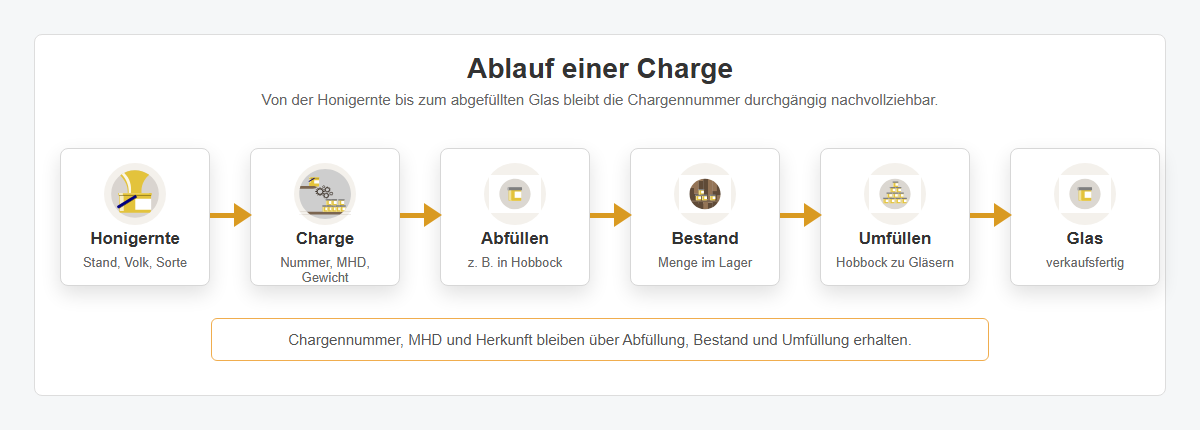
Der Ablauf zeigt, wie Honigernte, Charge, Abfüllung, Bestand und Umfüllung bis zum Glas zusammenhängen.
Für eine visuelle Anleitung zur Nutzung von BeeInTouch im Chargenmanagement findest du unten das passende Video.
Videoanleitung zum Chargenmanagement
Charge erstellen – Schritt für Schritt
Der Prozess beginnt in der Chargenübersicht. Dort legst du über das Plus-Symbol eine neue Charge an. Bei eigenem Honig wählst du anschließend die noch nicht zugeordneten Honigernten aus, kannst sie bei Bedarf nach Stand, Sorte, Erntejahr oder Volk gruppieren und daraus die Charge erzeugen. Danach prüfst du Chargennummer, Honigsorte, Gewicht, Wassergehalt, Schleuderdatum und Mindesthaltbarkeitsdatum. Nach dem Speichern erscheint die Charge in der Übersicht und kann später abgefüllt oder umgefüllt werden.
Schritt 1: Menü „Lager“ aufrufen
- Melde dich in BeeInTouch an.
- Öffne im Hauptmenü den Bereich „Lager“, um die Lagerverwaltung zu starten.
Schritt 2: Zum Bereich „Chargen“ wechseln
- Im Bereich „Lager“ findest du das Untermenü „Chargen“.
- Klicke auf „Chargen“, um die Übersicht aller Chargen zu sehen und neue Chargen anzulegen.
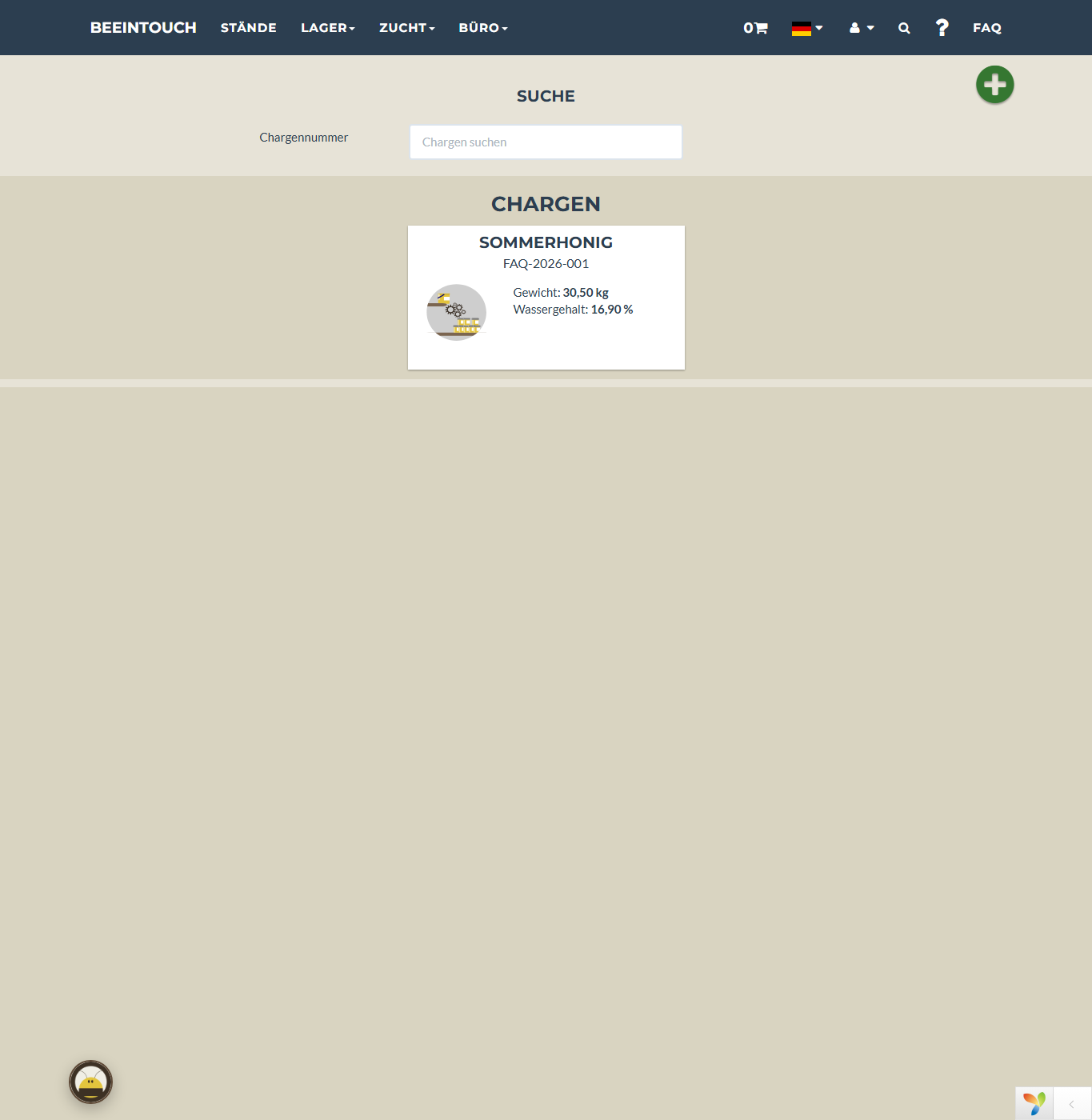
In der Chargenübersicht findest du bestehende Chargen und startest neue Chargen über das Plus-Symbol.
Schritt 3: Neue Charge anlegen
- Klicke auf das Plus-Symbol, um den Erstellungsprozess zu starten.
- Wähle „Eigener Honig“.
- Das System zeigt dir alle Honigernten an, die noch keiner Charge zugeordnet sind.
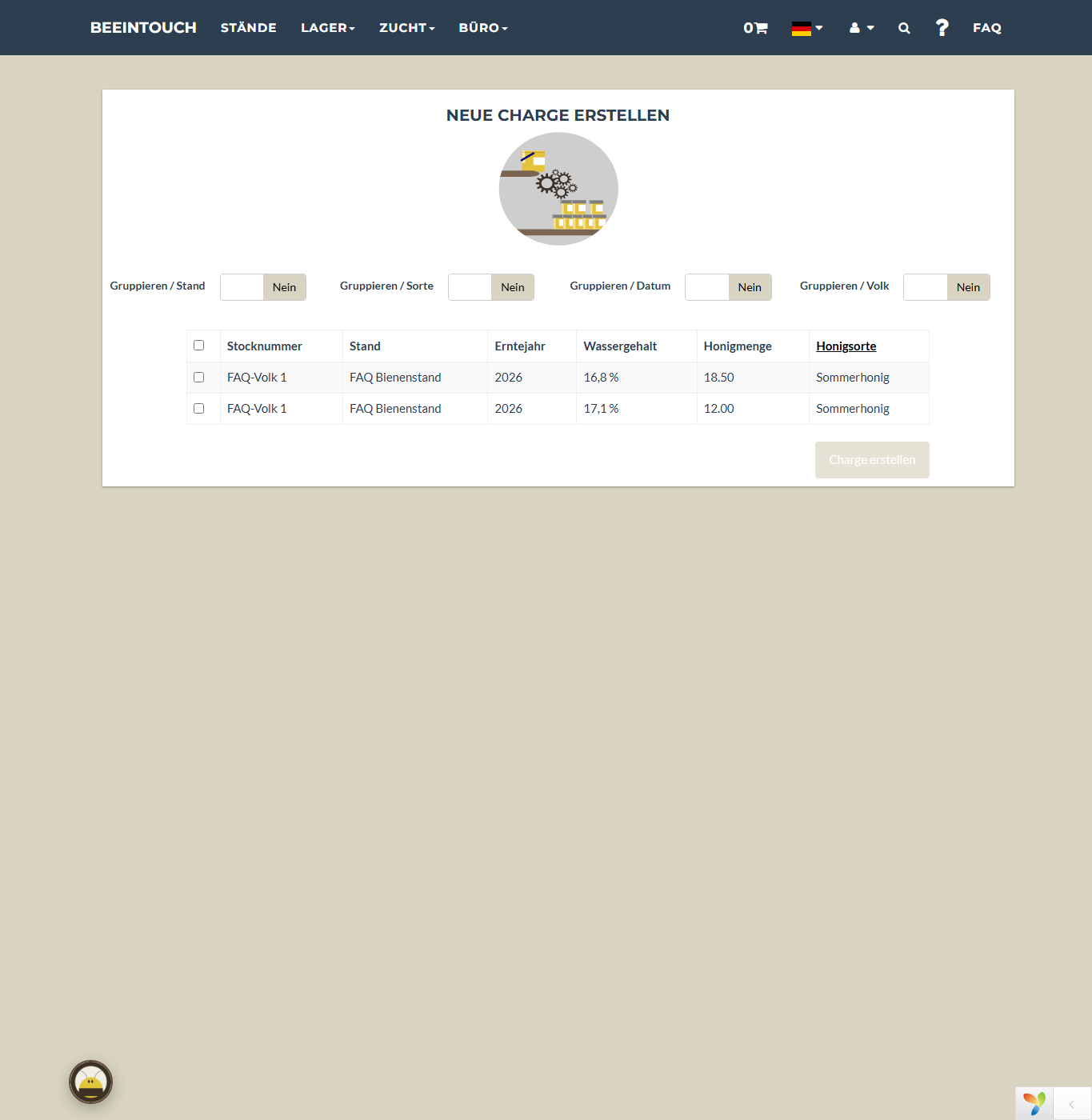
Beim Erstellen wählst du die Honigernten aus und kannst sie nach Stand, Sorte, Datum oder Volk gruppieren.
Schritt 4: Ernten zur Charge hinzufügen
- Gruppiere oder filtere nach Bedarf, z. B. nach Stand (Standort der Bienenvölker), Honigsorte (z. B. Linde), Erntejahr oder Volk.
- Markiere alle Ernten, die du zu einer Charge zusammenfassen möchtest.
Schritt 5: Charge erstellen
- Wähle „Charge erstellen“.
- BeeInTouch übernimmt automatisch Sorte, Stände und Völker der ausgewählten Ernten.
- Optional kannst du ein Bio-Zertifikat oder Analysen hinterlegen und der Charge zuordnen.
Schritt 6: Chargendaten festlegen
- Chargennummer: Vergib eine eindeutige Nummer für die Charge.
- Durchschnittlicher Wassergehalt: Wird aus den Ernten berechnet; du kannst ihn bei Bedarf anpassen (z. B. nach Laboranalyse).
- Mindesthaltbarkeitsdatum (MHD): Trage das MHD der Charge ein.
- Gesamtgewicht: Wird aus den Ernten summiert; Anpassung möglich (z. B. bei Klärverlusten).
- Dokumente: Lade Analysen, Hygieneprotokolle, Bio-Bescheide oder Etiketten-Layouts hoch.
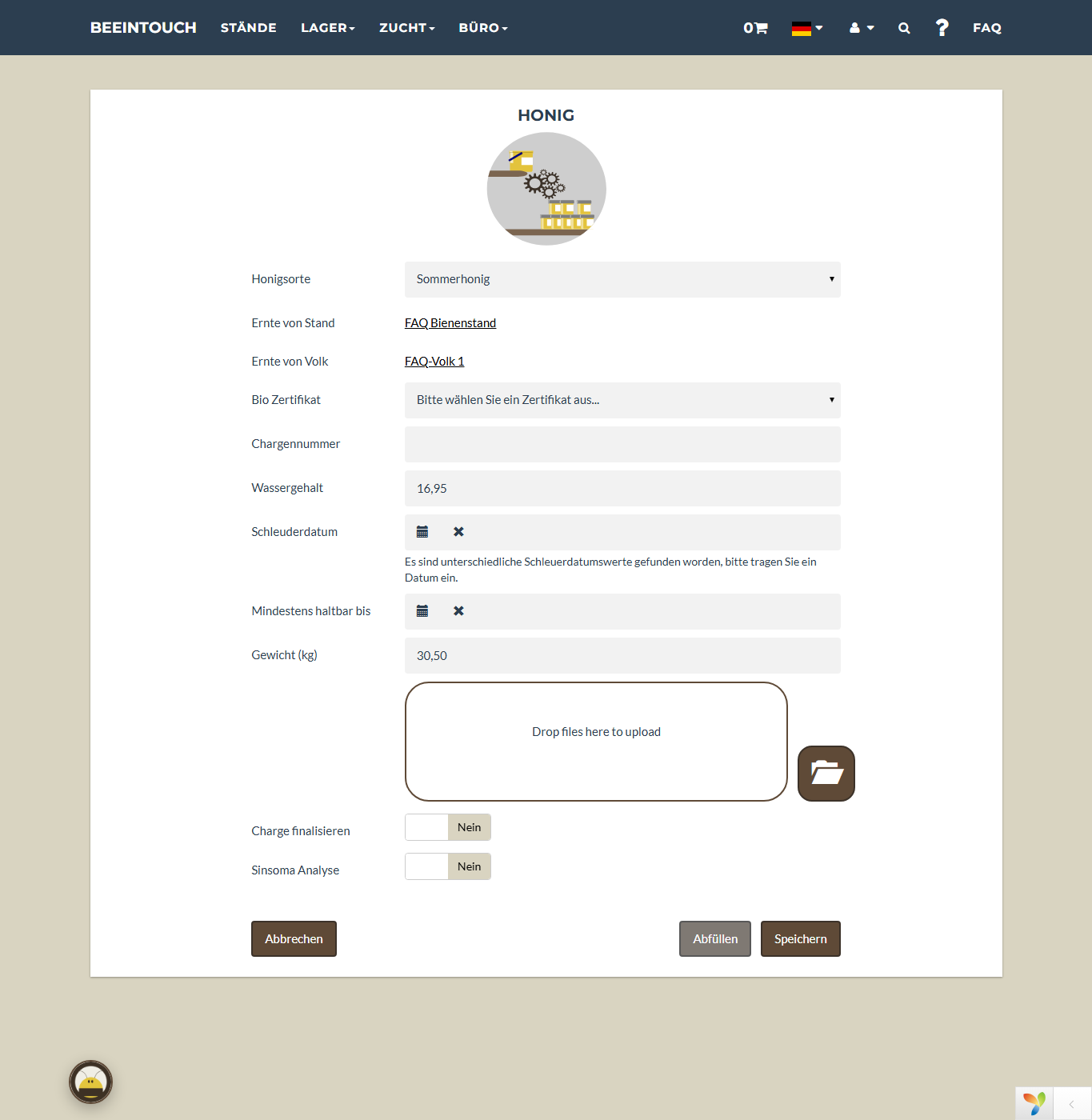
In den Chargendaten prüfst du Honigsorte, Stand, Volk, Wassergehalt, Gewicht, MHD und weitere Angaben vor dem Speichern.
Schritt 7: Charge finalisieren (optional)
- Prüfe alle Angaben sorgfältig.
- Du kannst die Charge sofort finalisieren oder später – nach Finalisierung sind Änderungen gesperrt (behördensicher).
Schritt 8: Speichern
- Klicke auf „Speichern“. Die Charge erscheint in der Übersicht.
- Zugeordnete Ernten werden aus der Liste der verfügbaren Ernten entfernt, da sie nun Teil der Charge sind.
Abfüllung und Umfüllung – Lager stets im Blick
Abfüllung der Charge in einen Hobbock
- Wähle im Menü „Lager“ die Charge und klicke auf „Abfüllen“.
- Wähle das Gebinde (z. B. Hobbock 40 kg).
- Gib die Menge ein (z. B. ein Hobbock mit 12,5 kg).
- Speichern: Der Bestand wird angelegt und die Abfüllung in der Charge dokumentiert.
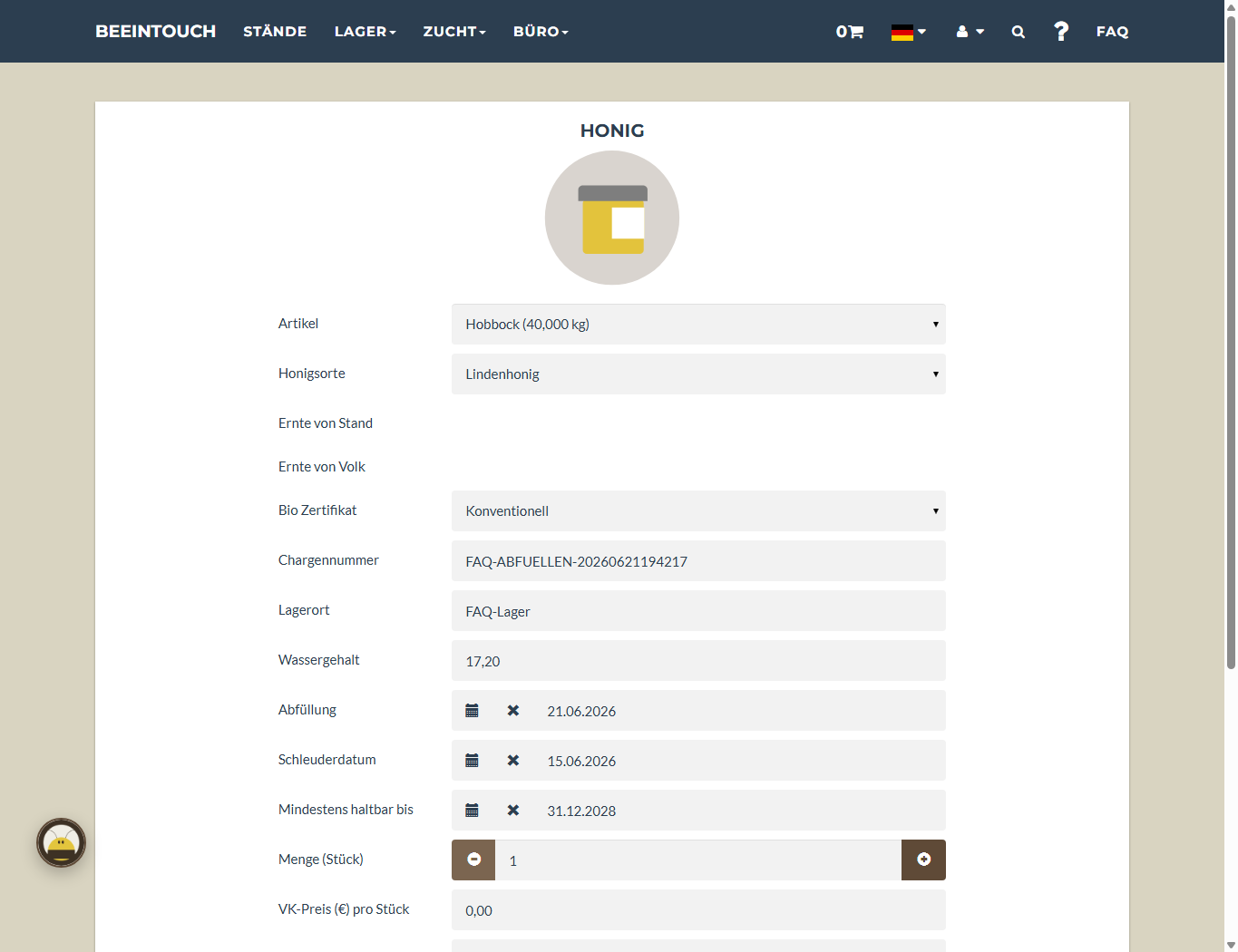
Beim Abfüllen wählst du Artikel, Menge und Abfülldatum; die Chargennummer bleibt am Bestand erhalten.
Umfüllung in Gläser (z. B. 250 g)
- Wähle im „Lager“ den Hobbock-Bestand, der umgefüllt werden soll.
- Klicke auf „Umfüllen“.
- Gib die Menge an (z. B. 2 kg) und wähle das Zielgebinde (z. B. 300 g-Glas).
- Lege die Anzahl der Gläser fest (z. B. 6 Gläser à 250 g).
- Speichern: Ein neuer Glas-Bestand wird angelegt, der Hobbock-Bestand entsprechend reduziert – die Zuordnung zur Charge bleibt erhalten.
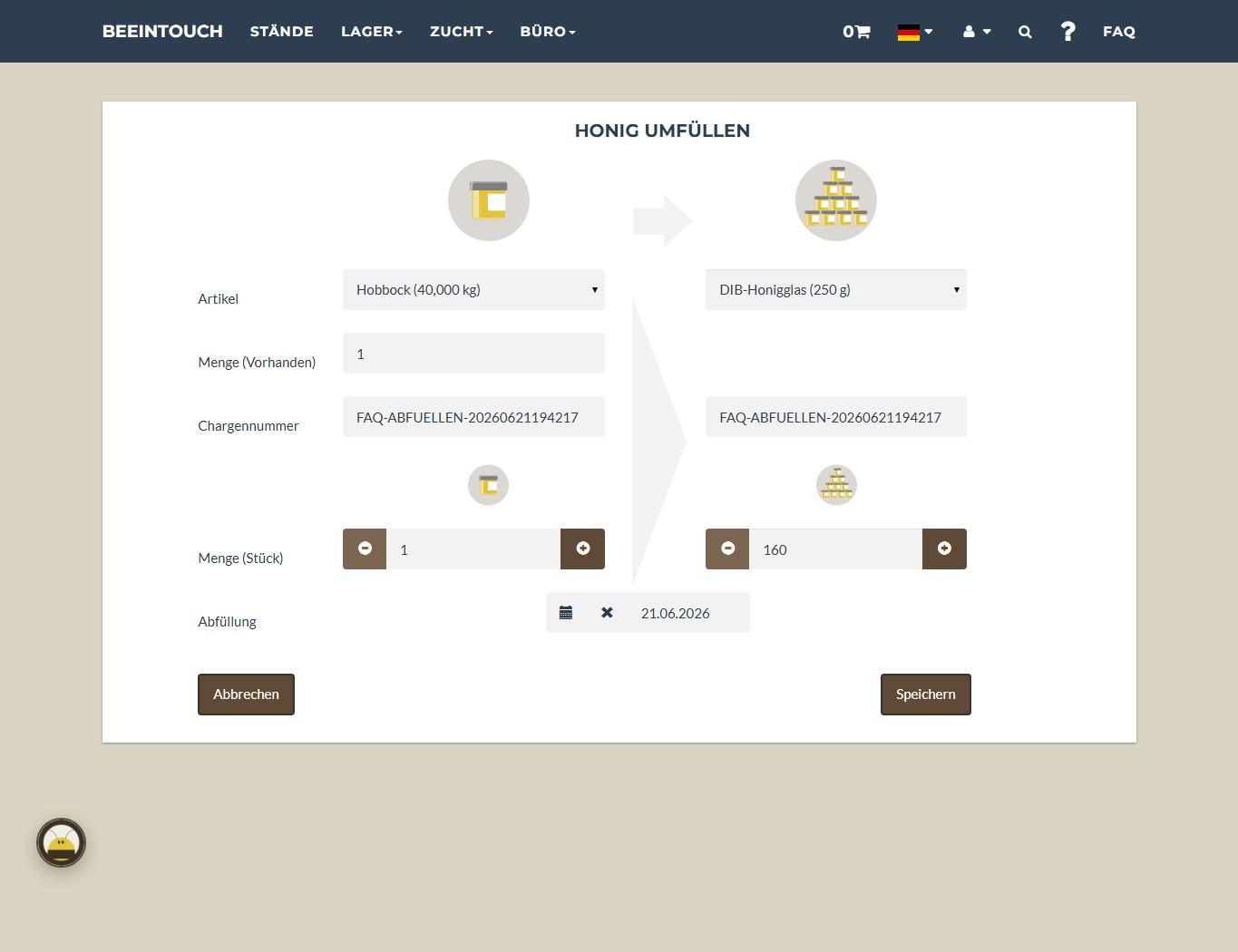
Beim Umfüllen wird links der Quellbestand reduziert und rechts der neue Zielbestand, zum Beispiel Gläser, angelegt.
Regionalität belegen – Premium-Preis souverän vertreten
Mit sauberen Chargen- und Standdaten zeigst du: Dein Honig hat Herkunft, Jahrgang und Charakter. Das ist der stärkste Unterschied zu anonymem Importhonig. Verweise in Verkaufsgesprächen, auf Etiketten oder deiner Website auf die dokumentierte Charge (inkl. Stand, Sorte und Jahr) – so verknüpfst du Transparenz mit einem nachvollziehbaren Preis. Kombiniere das am besten mit deiner Standbeschreibung – so sehen Kundinnen und Kunden gleichzeitig den Standort und die dazugehörige Charge.
Tipp: Wer Herkunft sehen kann (Bilder, Lagebeschreibung) und parallel die Charge nachvollzieht, versteht deinen Mehrwert sofort – ideal für Direktvermarktung, Hofladen und lokale Kooperationen. So grenzt du dich klar von Importhonig ab und vertrittst Premium-Preise souverän.